

In 2012, programmatic advertising was smart and scary in equal measure — built by people fluent in algorithms, sold to people fluent in budgets, with a trust gap sitting in between. No amount of spec sheets or performance data was going to close that gap on its own.
If the technology couldn’t be explained simply, the brand could be made likable. The real obstacle wasn’t capability, it was approachability. The brand strategy inverted the usual martech playbook of leading with “Look how smart we are!” Instead, Rocket Fuel led with “friendlier than you’d expect,” and let the sophistication speak for itself once the audience was already leaning in.
Over several years, the brand identity was built less like a single campaign and more like a running bit — the same warm, self-aware, slightly absurd voice showing up everywhere a skeptical buyer might encounter Rocket Fuel, in formats nobody expected from an ad-tech company.
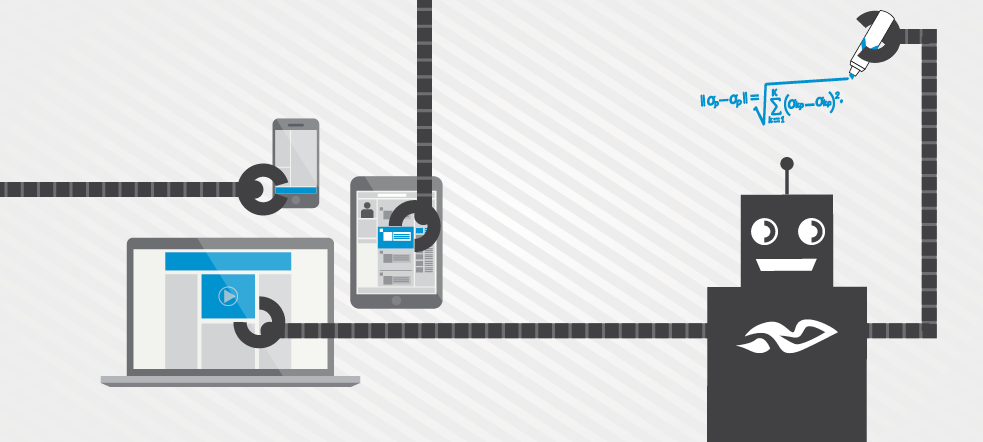
Internally, the strategy had a name: “Nerdy and Loveable.” The brand’s own internal mascot made the duality literal for a company that wanted to be taken seriously and still come across human. Our messaging North Star was Einstein’s “If you can’t explain it simply, you don’t understand it well enough.”
And it worked. A Q4 2013 client survey showed customers describing the brand as trustworthy, friendly, smart, and efficient. The humanizing approach was landing with the audience before the more visible campaigns below even launched.


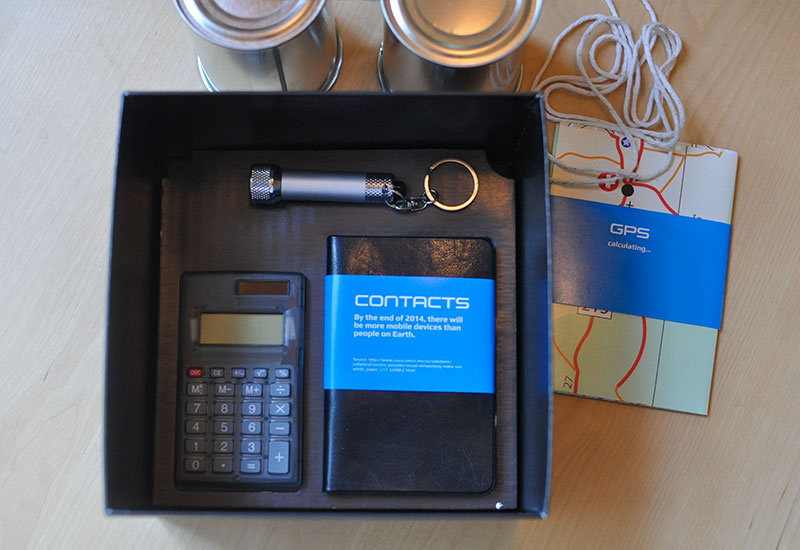
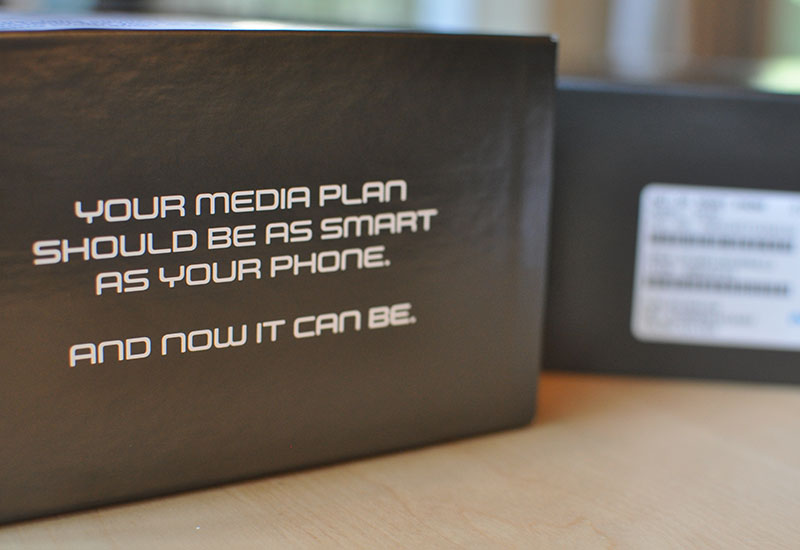
While competitors sent prospects free iPads, Rocket Fuel sent The Not-So-Smartphone to introduce our new mobile advertising solutions. Two tin cans on a string along with the analog ancestors of everything a smartphone does. The joke did double duty, working on an entry-level media planner’s desk and a senior executive’s desk without changing a word.
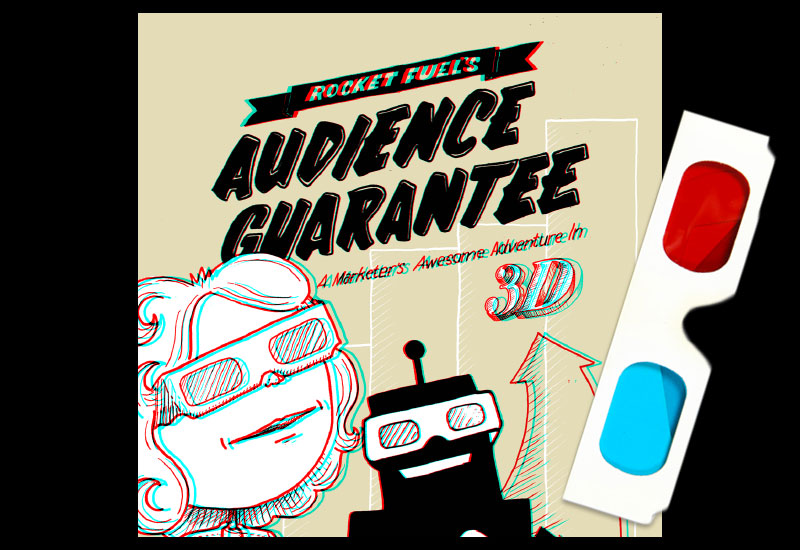
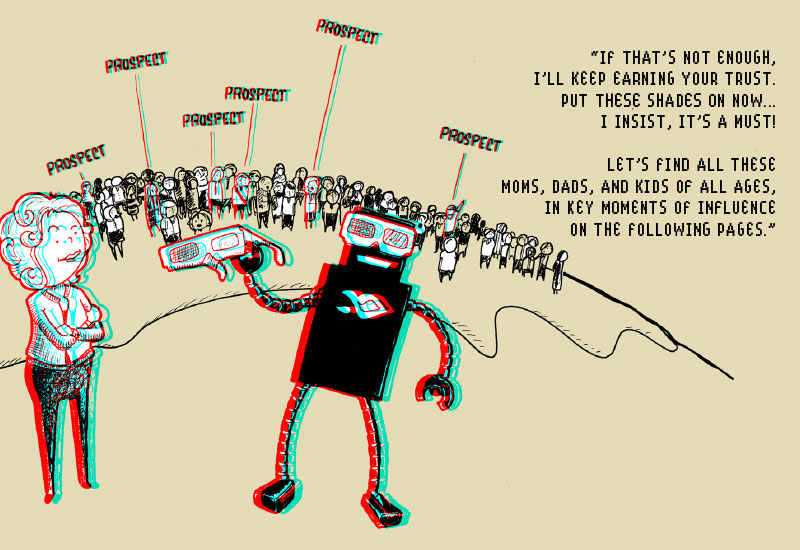
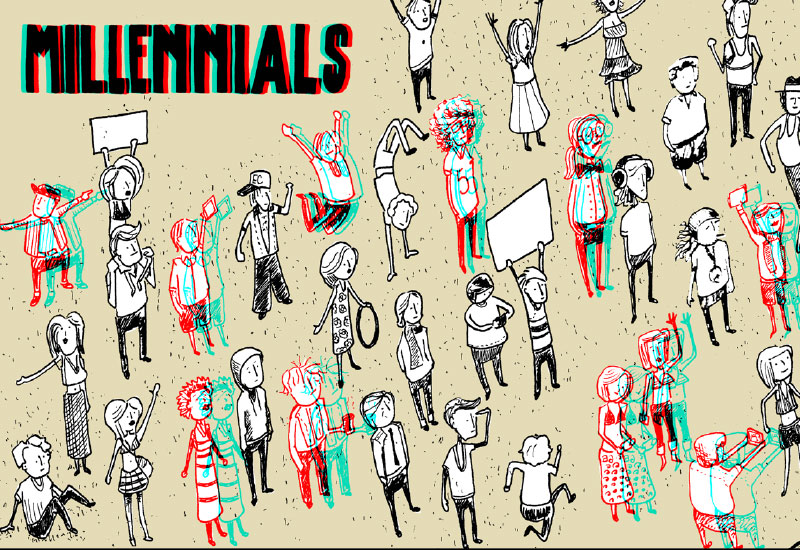
Rocket Fuel’s predictive technology was a genuinely hard thing to explain in 2013. So in the spirit of “Explain it to me like I’m 5,” we made a children’s book. Throughout the story, the “right” customers pop out in 3D as Rocket Fuel helps a marketer reach her audience on the right device at the right time.
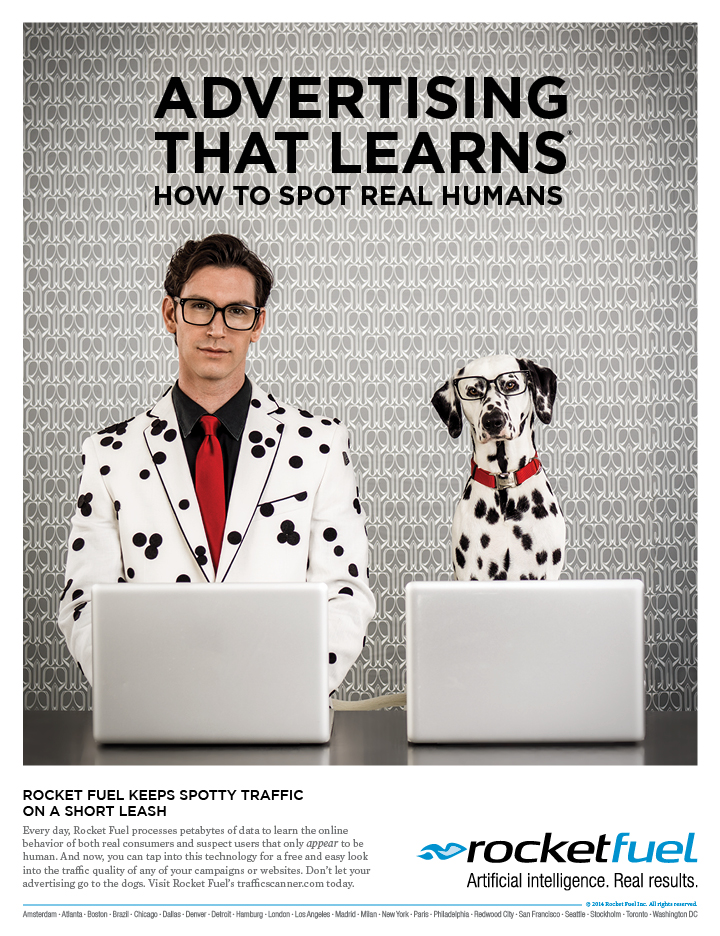
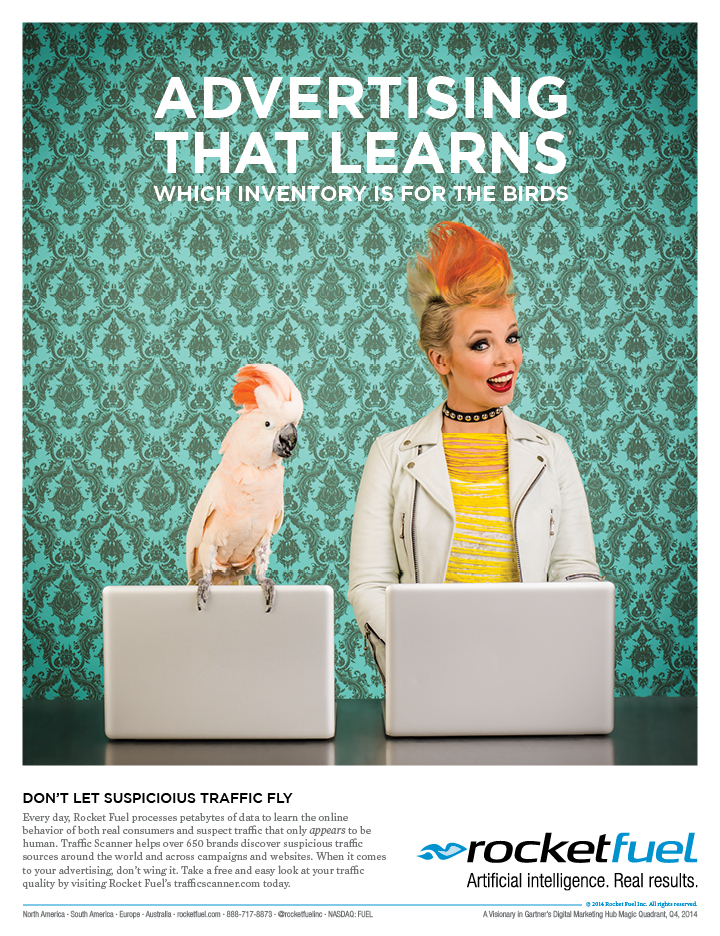
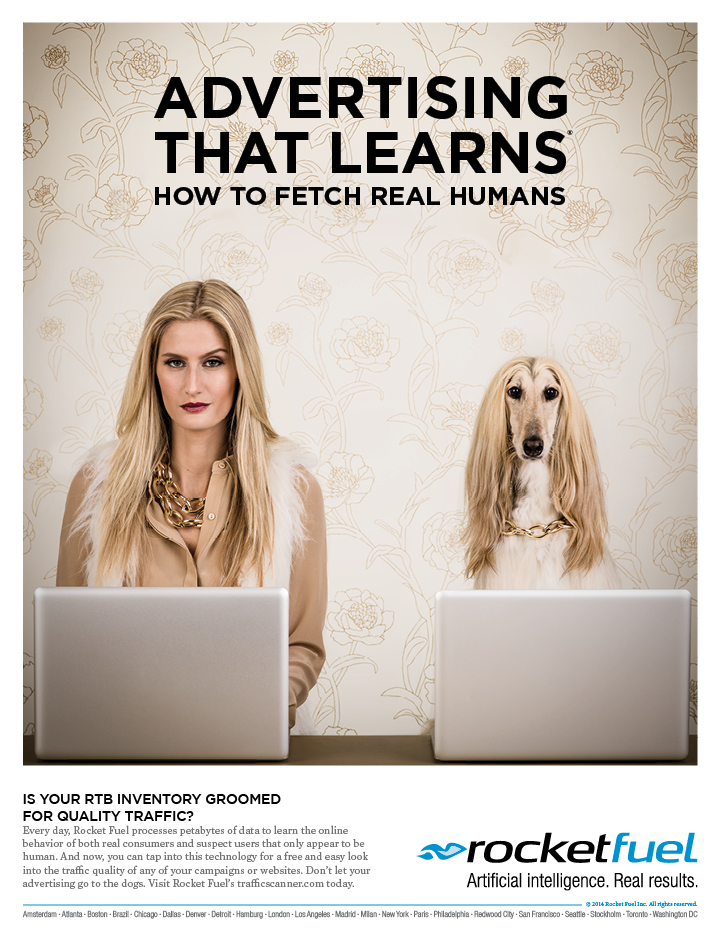
When Rocket Fuel launched Traffic Scanner — a free tool that detects “non-human” bot traffic hiding in a client’s ad data — the campaign turned a genuinely unglamorous problem (ad fraud) into a one-second visual joke: a lineup of faces and animals, daring the viewer to spot the “real” human. Identifying non-human traffic your ad data should be just as easy.
“Going from concept to launch in just over two weeks in the middle of an industry PR emergency about ad fraud was quite the experience. One day I pitched an idea, the next day I was on a plane to New York while scouting photographers, set builders, models, and yes… dogs and birds.”
-Skott B.


“Trustworthy. Friendly. Smart.” Not our words — theirs. A Q4 2013 client survey found customers already describing Rocket Fuel this way, unprompted, before the boldest campaigns had even launched.
The business grew tenfold over the years this brand strategy was in market — a technology company scaling only works if the people it’s asking for trust keep saying yes.
The valuation Rocket Fuel reached at IPO — proof the “nerdy and loveable” bet wasn’t just a creative flourish, it was a brand built to hold up under real financial scrutiny.
In 2012, programmatic advertising was smart and scary in equal measure — built by people fluent in algorithms, sold to people fluent in budgets, with a trust gap sitting in between. No amount of spec sheets or performance data was going to close that gap on its own.
If the technology couldn’t be explained simply, the brand could be made likable. The real obstacle wasn’t capability, it was approachability. The brand strategy inverted the usual martech playbook of leading with “Look how smart we are!” Instead, Rocket Fuel led with “friendlier than you’d expect,” and let the sophistication speak for itself once the audience was already leaning in.
Over several years, the brand identity was built less like a single campaign and more like a running bit — the same warm, self-aware, slightly absurd voice showing up everywhere a skeptical buyer might encounter Rocket Fuel, in formats nobody expected from an ad-tech company.
Internally, the strategy had a name: “Nerdy and Loveable.” The brand’s own internal mascot made the duality literal for a company that wanted to be taken seriously and still come across human. Our messaging North Star was Einstein’s “If you can’t explain it simply, you don’t understand it well enough.”
And it worked. A Q4 2013 client survey showed customers describing the brand as trustworthy, friendly, smart, and efficient. The humanizing approach was landing with the audience before the more visible campaigns below even launched.


While competitors sent prospects free iPads, Rocket Fuel sent The Not-So-Smartphone to introduce our new mobile advertising solutions. Two tin cans on a string along with the analog ancestors of everything a smartphone does. The joke did double duty, working on an entry-level media planner’s desk and a senior executive’s desk without changing a word.
Rocket Fuel’s predictive technology was a genuinely hard thing to explain in 2013. So in the spirit of “Explain it to me like I’m 5,” we made a children’s book. Throughout the story, the “right” customers pop out in 3D as Rocket Fuel helps a marketer reach her audience on the right device at the right time.
When Rocket Fuel launched Traffic Scanner — a free tool that detects “non-human” bot traffic hiding in a client’s ad data — the campaign turned a genuinely unglamorous problem (ad fraud) into a one-second visual joke: a lineup of faces and animals, daring the viewer to spot the “real” human. Identifying non-human traffic your ad data should be just as easy.
“Going from concept to launch in just over two weeks in the middle of an industry PR emergency about ad fraud was quite the experience. One day I pitched an idea, the next day I was on a plane to New York while scouting photographers, set builders, models, and yes… dogs and birds.”
-Skott B.


“Trustworthy. Friendly. Smart.” Not our words — theirs. A Q4 2013 client survey found customers already describing Rocket Fuel this way, unprompted, before the boldest campaigns had even launched.
The business grew tenfold over the years this brand strategy was in market — a technology company scaling only works if the people it’s asking for trust keep saying yes.
The valuation Rocket Fuel reached at IPO — proof the “nerdy and loveable” bet wasn’t just a creative flourish, it was a brand built to hold up under real financial scrutiny.
